
Hair Pins & Forks
Our hair pins and hair forks are carefully hand crafted from reclaimed, recycled or waste wood by Rainy.

This unusual handcrafted pin is made from Boxwood and Purpleheart. It features a dark purple top and collar. This highly figured pin has a fine pale grain running down the length of the piece. The wood is a subtle yellowish colour and is extremely strong and smooth.
Boxwood is a very strong, dense wood. Many gardens in Europe feature Boxwood in some shape or form as it is commonly used for formal topiary and parterres. The wood has been used in fine turnery, woodwind instruments, chess pieces and inlay work for many years. Older European cultures also found the medicinal and magical properties of this hardwearing dense wood. Used for thousands of years; Boxwood is possibly the hardest wood in Europe. Neanderthals fashioned digging sticks from Boxwood due to its strength. It has even been used as a substitute for ivory.
This piece has been salvaged locally by myself from a a very old Boxwood shrub that has stood for decades in a beautiful formal garden in a valley near Bath.
Purpleheart is a very strong wood from South America. This piece was left over from a local carpentry workshop. It is one of my favourite woods to work with. Sapele Mahogany comes from West, Central and East Africa. It is often used in furniture and cabinet making and as a veneer for marquetry. It is also used in the construction of musical instruments, for building boats and as a flooring material.
Measurements:
15.2 cm Long
2.5 cm Wide
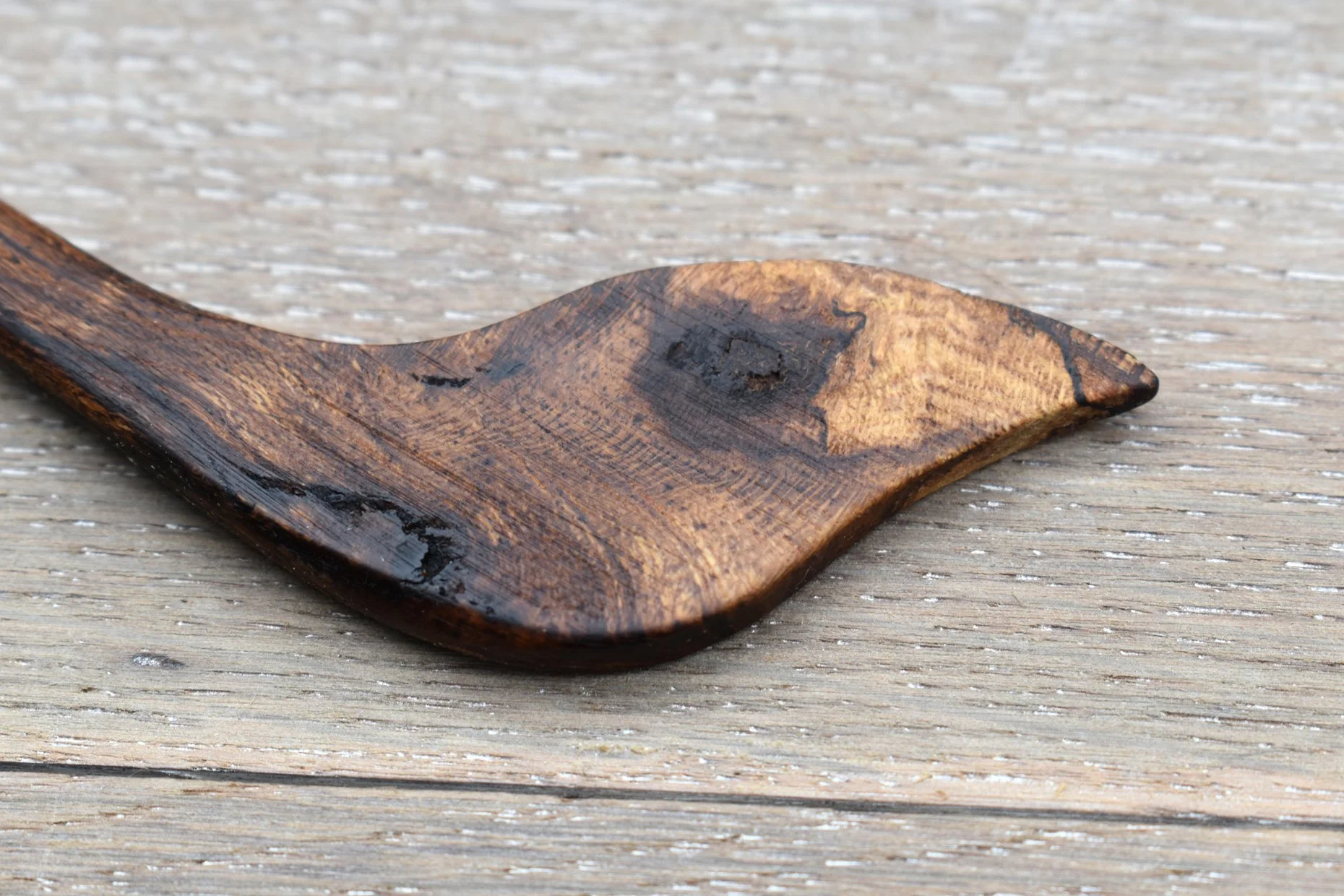
This small handcrafted hair pin is made from Laburnum Wood. It features a flat leaf design top with intricate grain and knot patterns on either side of its face. A lovely strong and stylish little pin.
Laburnum wood is a stunning wood found in southern Europe and here in the UK. Prized by furniture makers and luthiers this beautiful deep grained wood is often used for veneers. It is one of the few woods we have in the UK that feels and behaves like rosewood. Cross cut sections of this wood called 'oysters' have been used to make furniture for centuries. A stunning tree and a gorgeous wood, it never fails to impress. This piece was salvaged from a very old tree that had fallen in a storm in 2012. I've saved as much of the old dear as I could and I can't wait to see what further wonders lie beneath the bark
Measurements:
15.5cm Long
4.5cm Wide
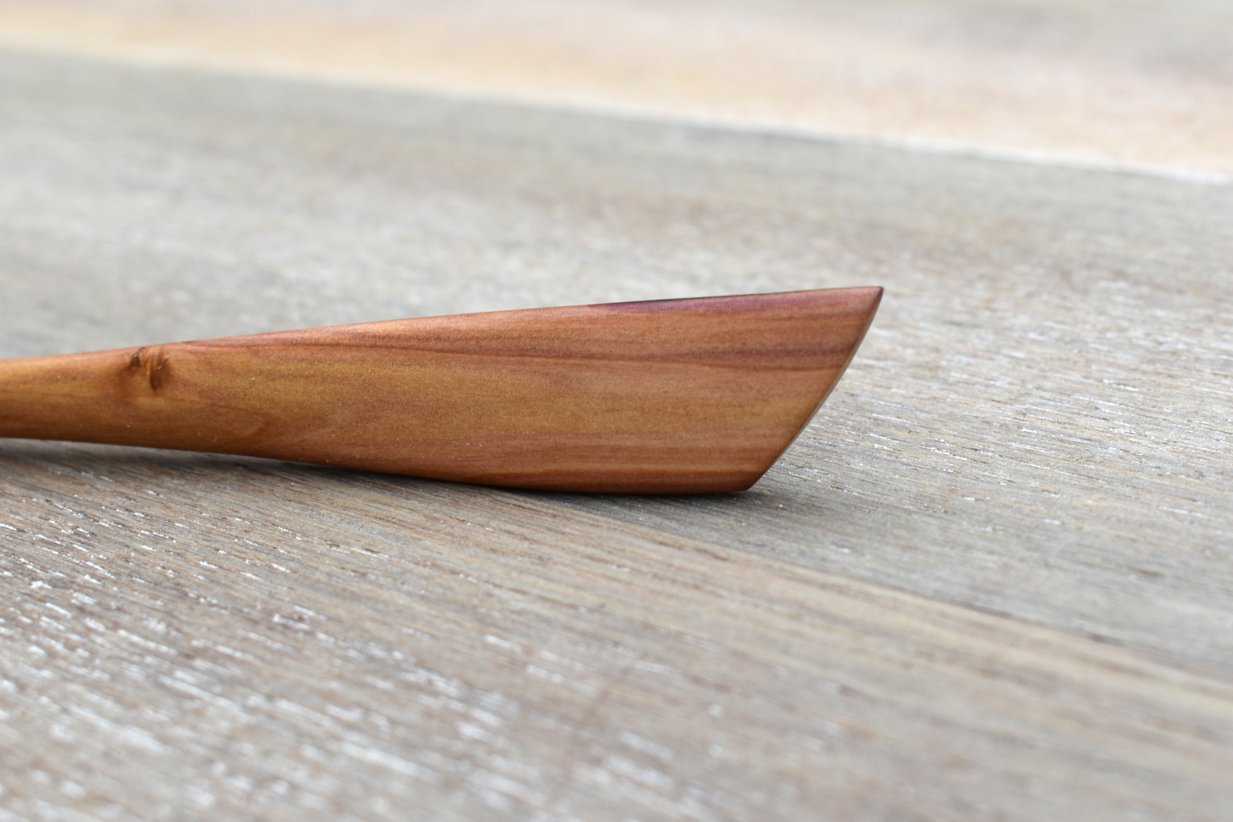
This slender handcrafted hair pin is made from fine grained lilac wood. It features a classic clean shaped top with a pith mark and pinkish purple grain patterns running down the pin. An elegant strong and slender pin.
Lilac is a beautiful flowering shrub that many gardeners are familiar with here in the UK. A native of Europe and Asia, these stunning plants produce heavily scented flowers for a short period in spring. It is occasionally used for small turned projects such as pens and bowls, as well as carved items, as it's a lovely strong wood. The lilac I have in stock is left over from pruning work I carried out on two old shrubs in 2019 in a garden in Bath.
Measurements:
17cm Long
1.8cm Wide
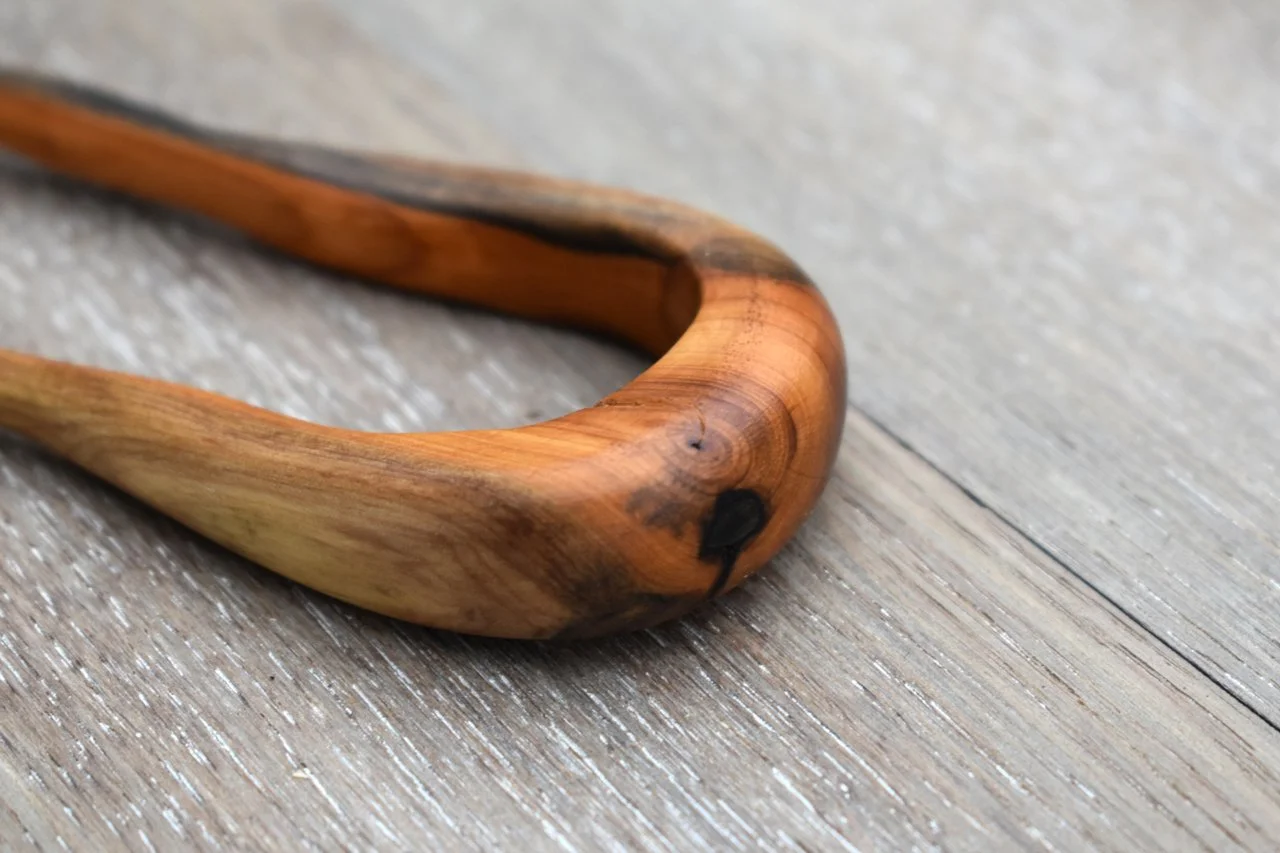
This small handcrafted hair fork is made from a stunning piece of Yew with contrasting deep grain patterns running down the pins and a clear knot featuring at the top. Yew is very strong making this a very sturdy and eye catching little fork.
Yew has been used for many centuries. Longbows were made from Yew in the middle ages. Pegs or 'treenails' were cut for Viking ships. Furniture makers use Yew to form the bent parts of Windsor chairs. Pre-Christian cultures regarded the Yew tree as sacred. Possibly because of their longevity they became symbols of immortality. Drooping branches of a Yew can root and form a circle of new trunks around the original tree. Later the Yew came to symbolise death and resurrection in Celtic culture. Thanks to research into the properties of the Pacific Yew bark, and a subsequent discovery that the European Yew holds similar properties called alkaloids in its leaves, we now harness these alkaloids for treating ovarian and breast cancer. It remains one of the longest-lived trees on earth. One of the world's oldest surviving wooden artefacts is a yew spear head, found in 1911 in Essex, UK. It is estimated to be about 450,000 years old.
The Yew in this piece has been gathered from pruning work I have carried out on several ancient Yew trees in the surrounding villages and whilst gathering wood to make Ogham sticks.
Measurements:
13.5cm Long
4.8cm Wide
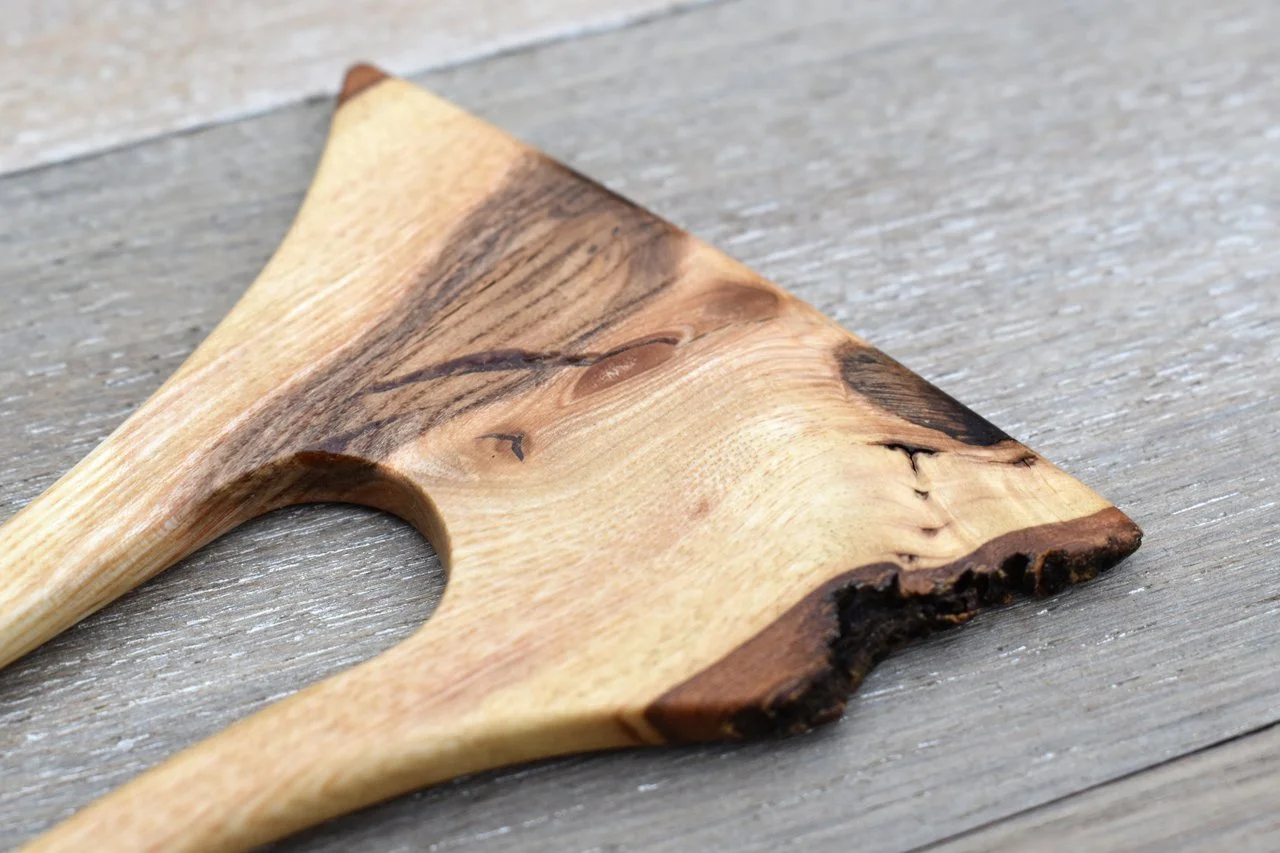
This large, wide handcrafted hair fork is made from Ash wood with contrasting coloured grain patterns at the top and live edge bark at the sides. It makes for a really eye catching piece. Perfect for big, volumous hair.
Ash is an amazing tree. It's part of the ‘Sacred Triad’ of Oak, Ash and Thorn, and the Irish ‘Seven Noble Trees’. European Ash is a prolific species forming a very important role in the ecosystem of woodlands across Europe. We are loosing many Ash trees due to Ash die back and so it is an abundant timber at the moment. This Ash was gathered from tree work and pruning jobs I carried out in a woodland in a valley near Bath.
Measurements:
17.2cm Long
8.7cm Wide
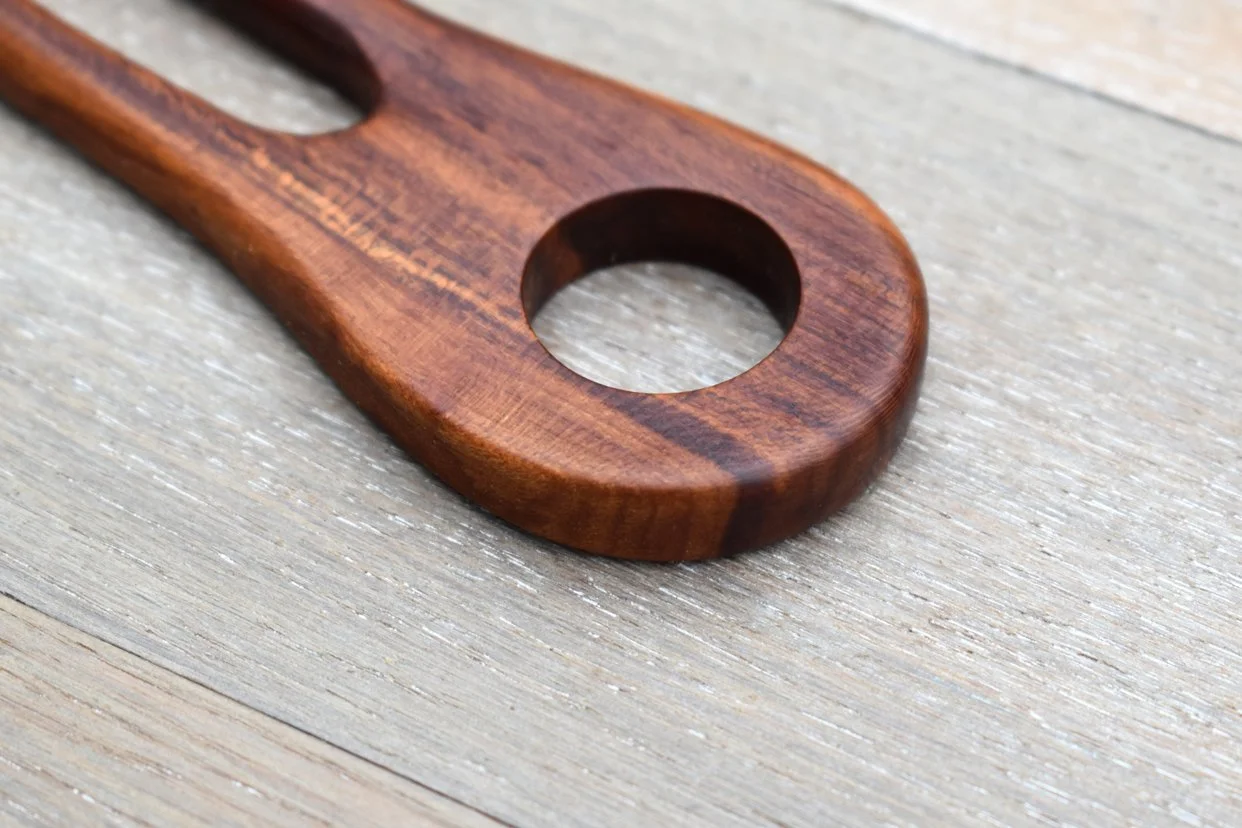
This extra long handcrafted hair fork is made from a lustrous deep reddish Greengage wood with stunning grain patterns running down the piece. The top features a perfect circle through the head making for a particularly eye catching piece. Perfect for big, volumous hair.
Greengage trees have beautiful flowers in the spring that are popular with moths, butterflies and other pollinators and delicious fruit later in the year that provide food for many animals.
Greengage wood has amazing reddish purple colours throughout it’s often gnarly grain.
The Greengage I have in stock has been gathered from pruning work we have carried out in our own garden.
Measurements:
18.8cm Long
4.5cm Wide
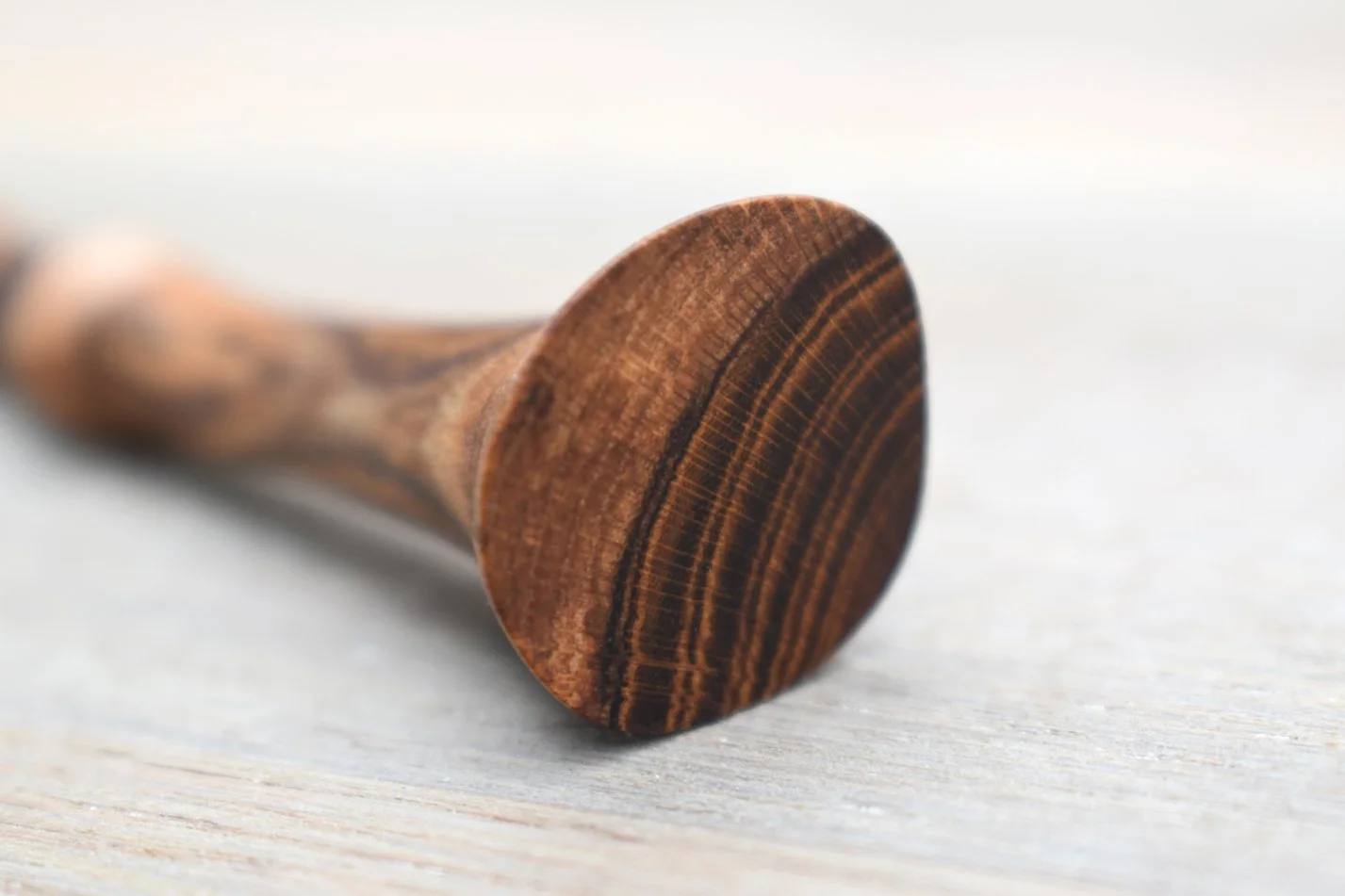
This handcrafted hair pin is made from vibrant Laburnum, pale Beech, dark Purple Heart and Walnut wood. The top is Laburnum with a beautiful grain and a small patch of spalting. The collar consists of a band of Beech wood into Black Walnut and Purple Heart . The rest of the pin is Laburnum wood with a deep grained heartwood and a contrasting sapwood curve. This is a lovely strong pin with lots of unique character.
Laburnum wood is a stunning wood found in southern Europe and here in the UK. Prized by furniture makers and luthiers this beautiful deep grained wood is often used for veneers. It is one of the few woods we have in the UK that feels and behaves like rosewood. Cross cut sections of this wood called 'oysters' have been used to make furniture for centuries. A stunning tree and a gorgeous wood, it never fails to impress. This piece was salvaged from a very old tree that had fallen in a storm in 2012. I've saved as much of the old dear as I could and I can't wait to see what further wonders lie beneath the bark.
European Beech is commonly found across Europe and western Asia. It has been used for centuries in furniture making and for building musical instruments. This piece was left over from reclaimed planks that I used to build my workshop bench. Research has revealed that Beech trees prefer the company of other beech trees and often fuse their root systems together to equalise their photosynthesis. In this way the trees can share immunity and strength.
American Black Walnut grows in Canada and Northern America. It is a prized wood for cabinetmaking and provides some pretty tasty nuts. The hair pin has been made from wood that would have otherwise been thrown away or burnt.
Purpleheart is a very strong wood from south America. This piece was left over from a local carpentry workshop. It is one of my favourite woods to work with. Sapele Mahogany comes from West, Central and East Africa. It is often used in furniture and cabinet making and as a veneer for marquetry. It is also used in the construction of musical instruments, for building boats and as a flooring material.
Measurements:
16.4cm Long
2.4cm Wide
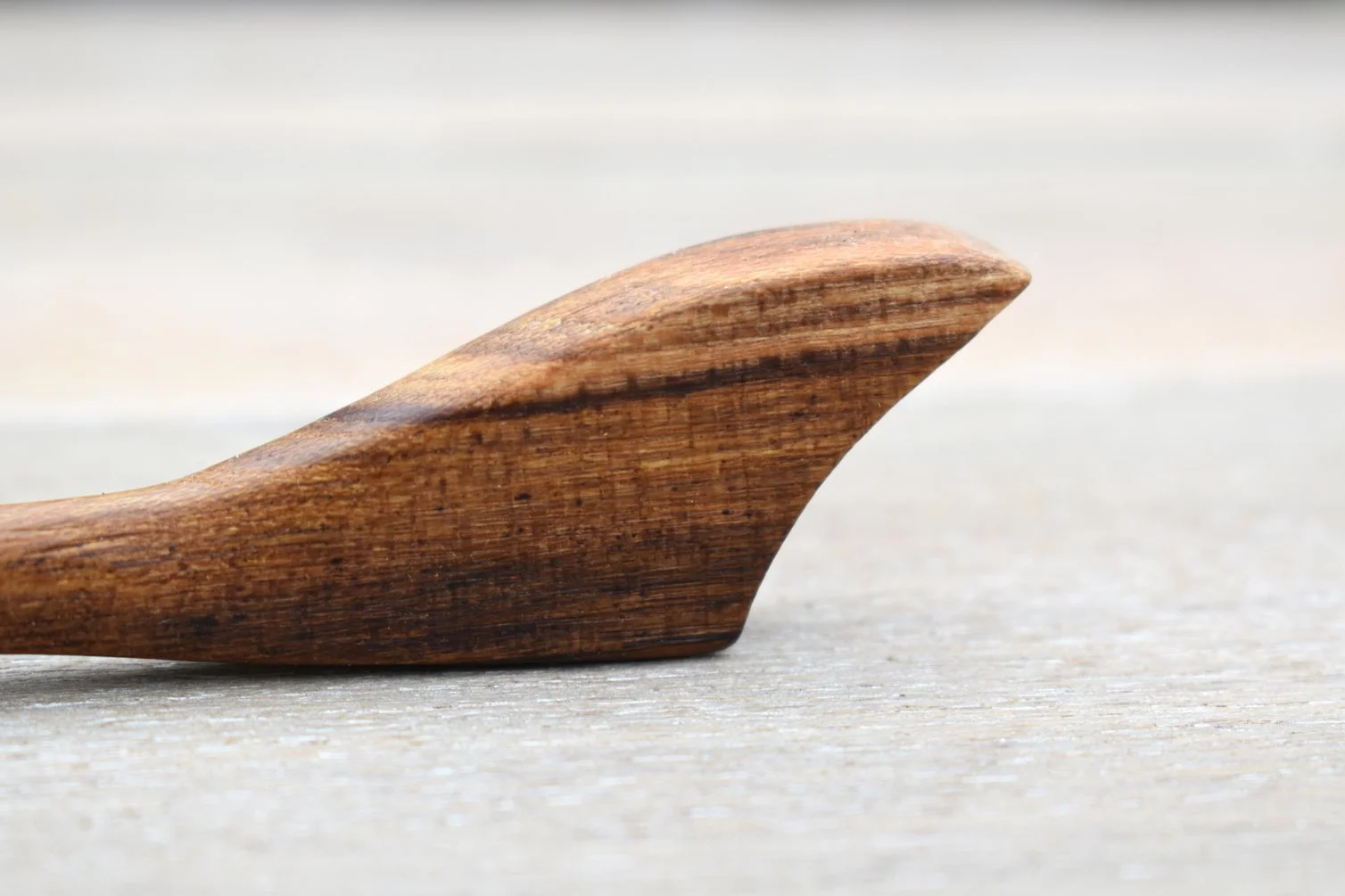
This small handcrafted hair pin is made from Laburnum Wood. It features a curved design at the top with intricate contrasting grain patterns and clear end-grain. A lovely strong and stylish little pin.
Laburnum wood is a stunning wood found in southern Europe and here in the UK. Prized by furniture makers and luthiers this beautiful deep grained wood is often used for veneers. It is one of the few woods we have in the UK that feels and behaves like rosewood. Cross cut sections of this wood called 'oysters' have been used to make furniture for centuries. A stunning tree and a gorgeous wood, it never fails to impress. This piece was salvaged from a very old tree that had fallen in a storm in 2012. I've saved as much of the old dear as I could and I can't wait to see what further wonders lie beneath the bark
Measurements:
15.4cm Long
2.5cm Wide
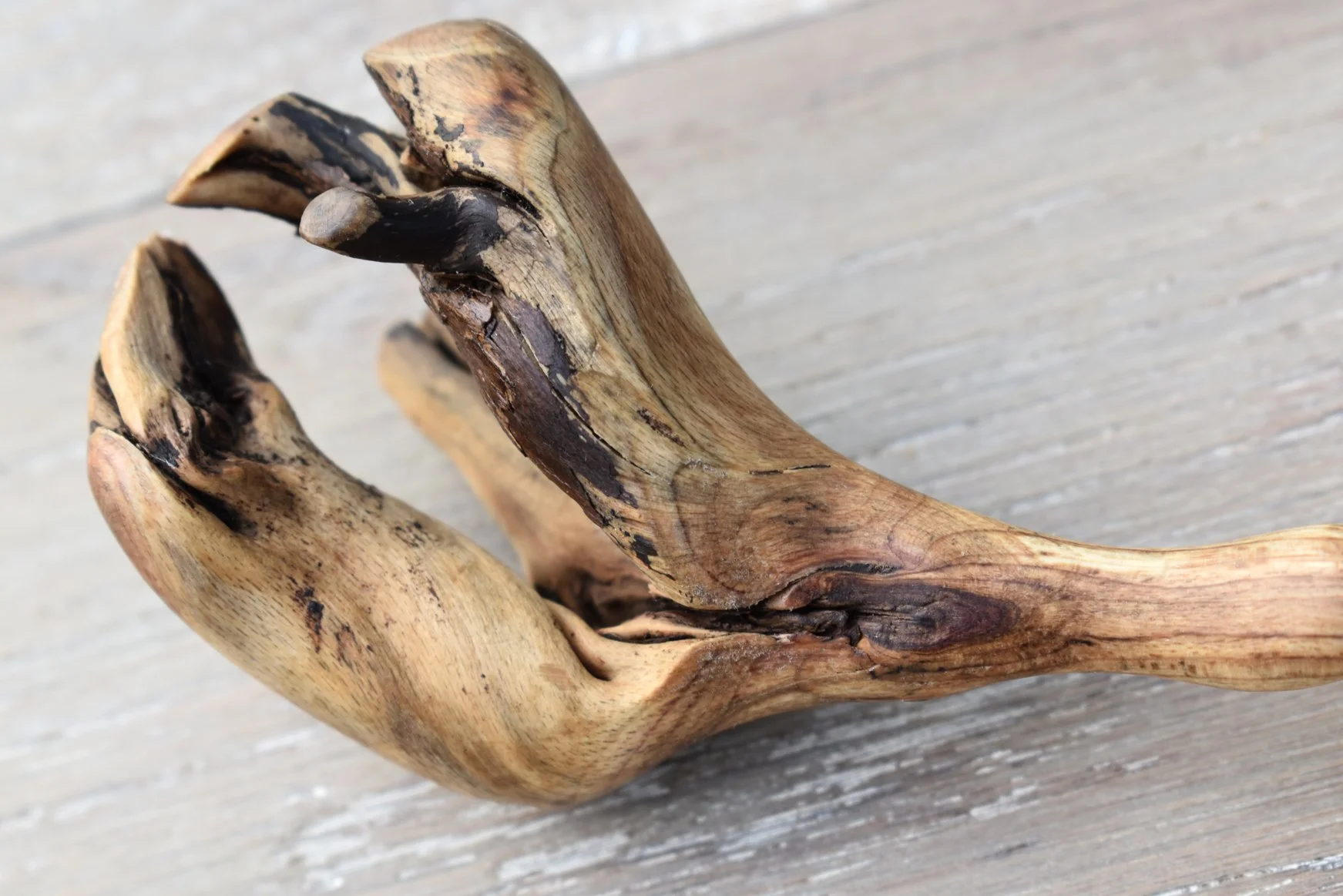
This unusual handcrafted pin is made from lavender wood. It features a natural gnarled and twisted 'fascinator' top that is sure to catch the eye. The length is contoured and smooth with fine grain patterns running down the entire piece.
Lavender is a prised plant in the mint family. It has been widely used across Asia, The Middle East Europe and northern and eastern Africa for centuries. Best known for it's stunning flowers, unmistakable fragrance and powerful oil, this herb is a truly wonderful plant. Anyone who has stood in the middle of a lavender field can attest to this! It's a favourite herb in English cottage gardens thanks to the Romans who first introduced it to Britain and named the herb Lavare, after their word for 'to bathe'. Lavender boasts many medicinal and magical attributes and is famed for it's calming properties. It was ancient Arabia that first farmed the herb for it's potent oil.
The wood from lavender is rarely used and usually discarded once the old plants have lost their vigour. I have been so excited to work with this Lavender that came from a local garden in Wiltshire after a hard prune a couple of years ago. It has quickly become one of my favourite discoveries for making pins.
Measurements:
16.2 cm Long
6.0 cm Wide
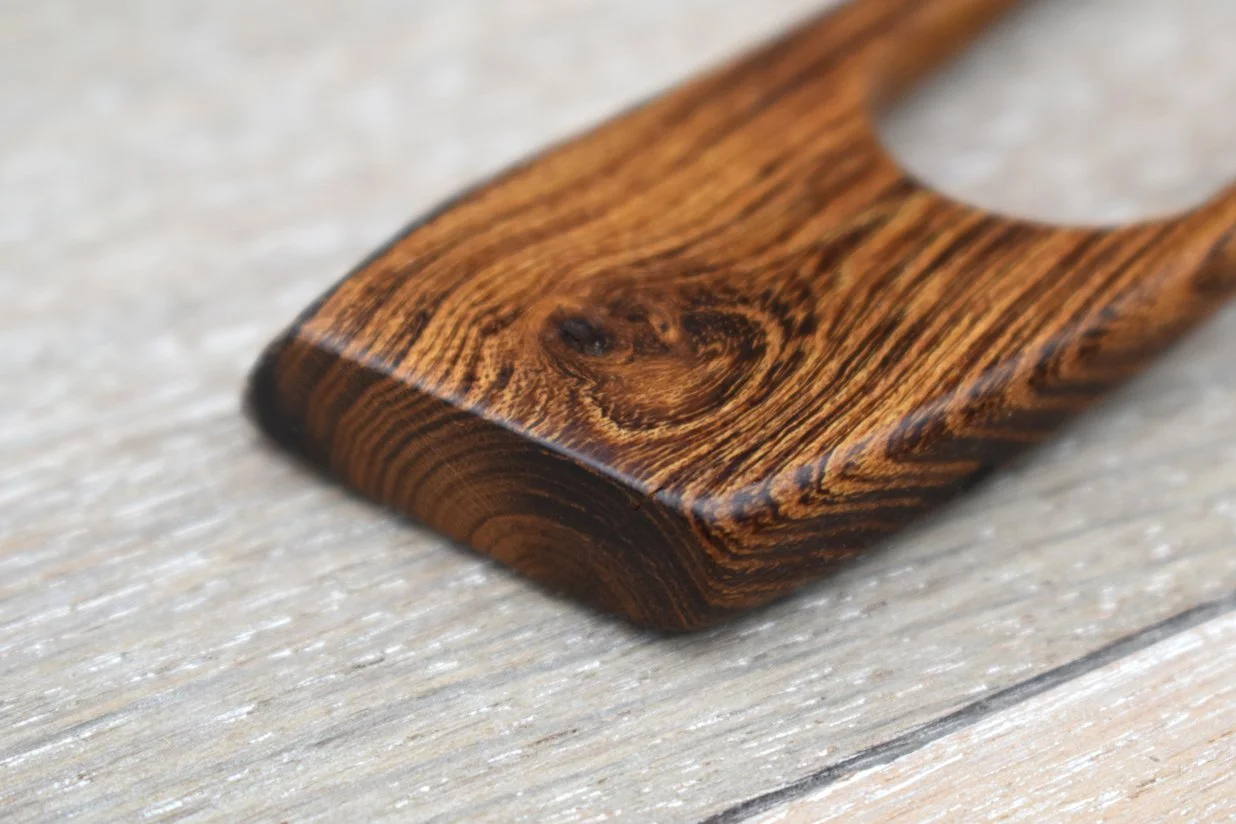
This handcrafted hair fork is made from deep lustrous Laburnum wood. It features contrasting colour and grain with a clear knot pattern at the top and defined contrasting grain running down the pins. A stunning and sturdy fork.
Laburnum wood is a stunning wood found in southern Europe and here in the UK. Prized by furniture makers and luthiers this beautiful deep grained wood is often used for veneers. It is one of the few woods we have in the UK that feels and behaves like rosewood. Cross cut sections of this wood called 'oysters' have been used to make furniture for centuries. A stunning tree and a gorgeous wood, it never fails to impress. This piece was salvaged from a very old tree that had fallen in a storm in 2012. I've saved as much of the old dear as I could and I can't wait to see what further wonders lie beneath the bark.
Measurements:
15.7cm Long
3.3cm Wide
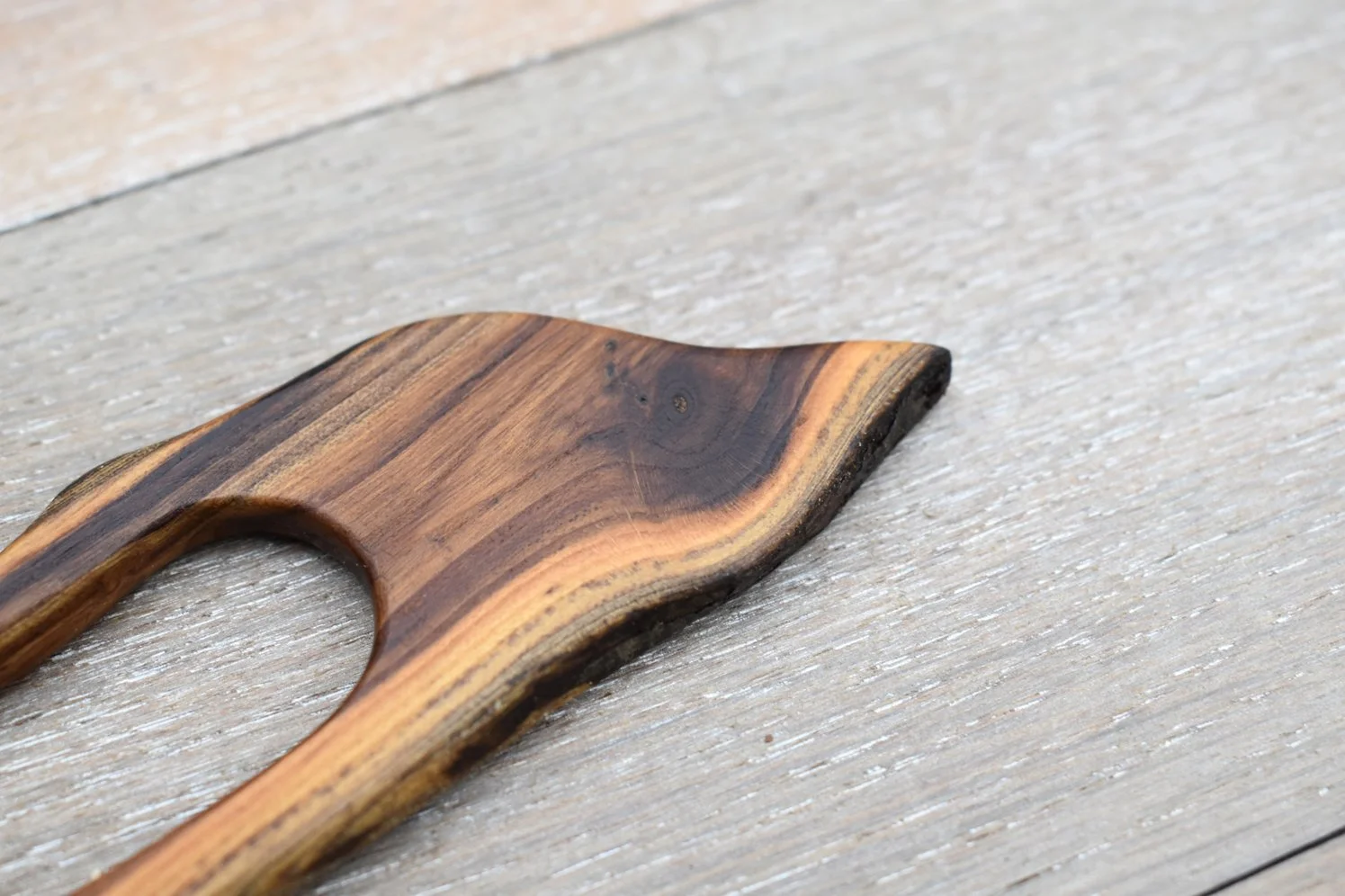
This handcrafted hair fork is made from a stunning piece of Elaeagnus Quicksilver wood. It features very dark bark and grain at the top with a pith mark and a curved end design. a fine contrasting coloured grain runs down the contoured pins. A strong, stunning, eye catching fork.
This handcrafted hair fork is made from Elaeagnus wood. It has an intricate rippling grain that contrasts with a light yellowish hue and a deeper brown. The top features a prominent knot and bark with segmented grading at the edges.
Elaeagnus is a commonly found shrub here in UK gardens. Quicksilver is a lesser known variety with a more slender leaf than it's more common cousin. Elaeagnus has mostly been used for knife scales, bowls and pens etc as it is often multi stemmed. This shrub hides some impressive grain. Some know the tree as Russian Olive as it can resemble Olive wood.
This piece was pruned from a well established shrub here in Wiltshire in 2020.
Measurements:
17cm Long
3.7cm Wide
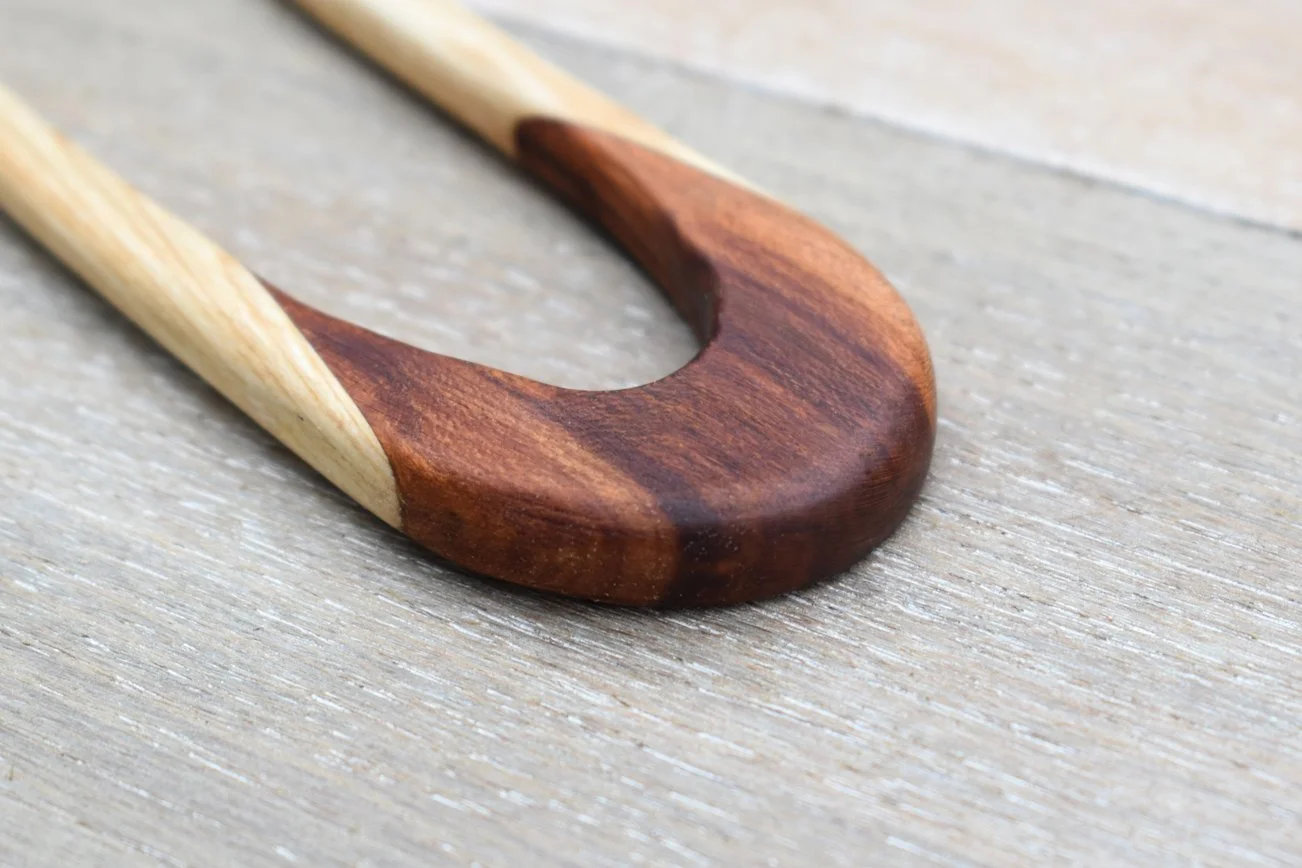
This compact handcrafted hair fork is made from a lustrous deep Greengage wood with clear dark grain patterns at the top with contrasting ash pins. An interesting and eye catching fork.
Ash is an amazing tree. It's part of the ‘Sacred Triad’ of Oak, Ash and Thorn, and the Irish ‘Seven Noble Trees’. European Ash is a prolific species forming a very important role in the ecosystem of woodlands across Europe. We are loosing many Ash trees due to Ash die back and so it is an abundant timber at the moment. This Ash was gathered from tree work and pruning jobs I carried out in a woodland in a valley near Bath.
Greengage trees have beautiful flowers in the spring that are popular with moths, butterflies and other pollinators and delicious fruit later in the year that provide food for many animals.
Greengage wood has amazing reddish purple colours throughout it’s often gnarly grain.
The Greengage I have in stock has been gathered from pruning work we have carried out in our own garden.
Measurements:
13.7cm Long
4cm Wide

This strong handcrafted hair pin is made from Beech, Purpleheart, Oak and European Walnut wood. The main length of the pin is made of pale flecked beech that meets the deep purple brown hue of Purpleheart wood. A small band of English Oak then meets the final Walnut wood top with dark flecked patterns on a lighter background. This is a really unusual design and one I hope to continue to explore. The thickness of the pin and the use of Beech make for a very strong pin that can handle the toughest of hair styles.
European Beech is commonly found across Europe and western Asia. It has been used for centuries in furniture making and for building musical instruments. This piece was left over from reclaimed planks that I used to build my workshop bench. Research has revealed that Beech trees prefer the company of other beech trees and often fuse their root systems together to equalise their photosynthesis. In this way the trees can share immunity and strength.
Purpleheart is a very strong wood from South America. This piece was left over from a local carpentry workshop. It is one of my favourite woods to work with.
The mighty Oak is widespread throughout the British Isles and part of the ‘Sacred Triad’ of Oak, Ash and Thorn, and the Irish ‘Seven Noble Trees’. It has long been thought of as the King of the Woods. The tree of endurance, strength and triumph. The adjective 'durable' comes from the ancient celtic name for the oak - Duir. As the month of Duir has the summer solstice in it, the Oak is a powerful symbol and deeply connected to the summer solstice. The word "Duir" comes from the Sanskrit "Dwr" which means "Door". It is the door to the three worlds of the Shaman.
European Walnut grows in south west Asia, Turkey and Europe. It has been used for many years in cabinet work and marquetry and provides some pretty tasty nuts. The wood to make this hair fork came from a very old tree in Bath that was cut down due to disease and rot. Many were sad to see it go. A tree surgeon friend kindly gave me some pieces that were destined to be burnt or thrown away in an effort to honour the life of such a Great tree.
Measurements:
15.5 cm Long
1.8 cm Wide
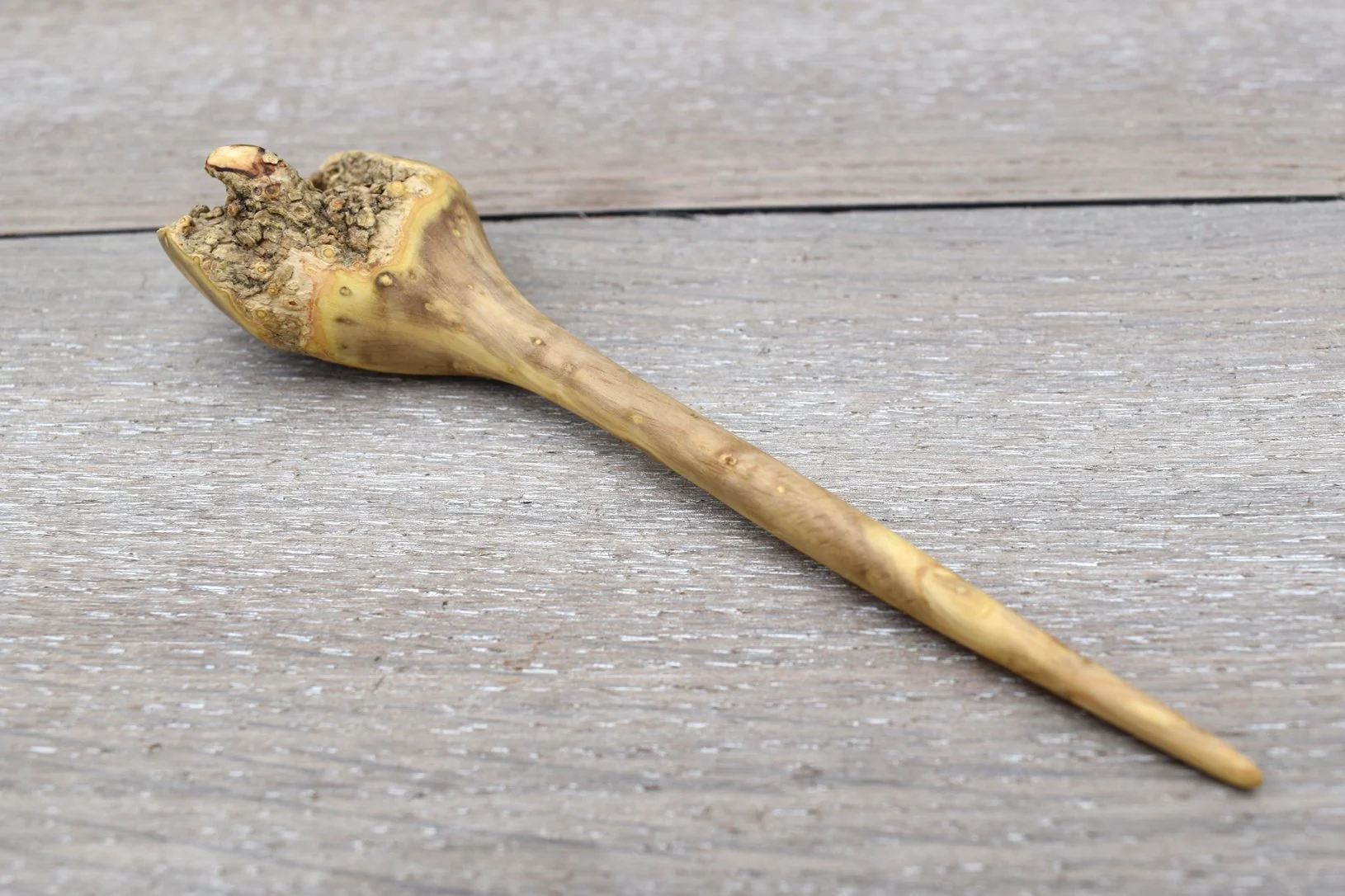
This unusual handcrafted pin is made from Boxwood. It features live bark at the top with a fine pale grain running down the length of the piece. The wood is a subtle yellowish colour and is extremely strong and smooth.
Boxwood is a very strong, dense wood. Many gardens in Europe feature Boxwood in some shape or form as it is commonly used for formal topiary and parterres. The wood has been used in fine turnery, woodwind instruments, chess pieces and inlay work for many years. Older European cultures also found the medicinal and magical properties of this hardwearing dense wood. Used for thousands of years; Boxwood is possibly the hardest wood in Europe. Neanderthals fashioned digging sticks from Boxwood due to its strength. It has even been used as a substitute for ivory.
This piece has been salvaged locally by myself from a a very old Boxwood shrub that has stood for decades in a beautiful formal garden in a valley near Bath.
Measurements:
13cm Long
3.2cm Wide
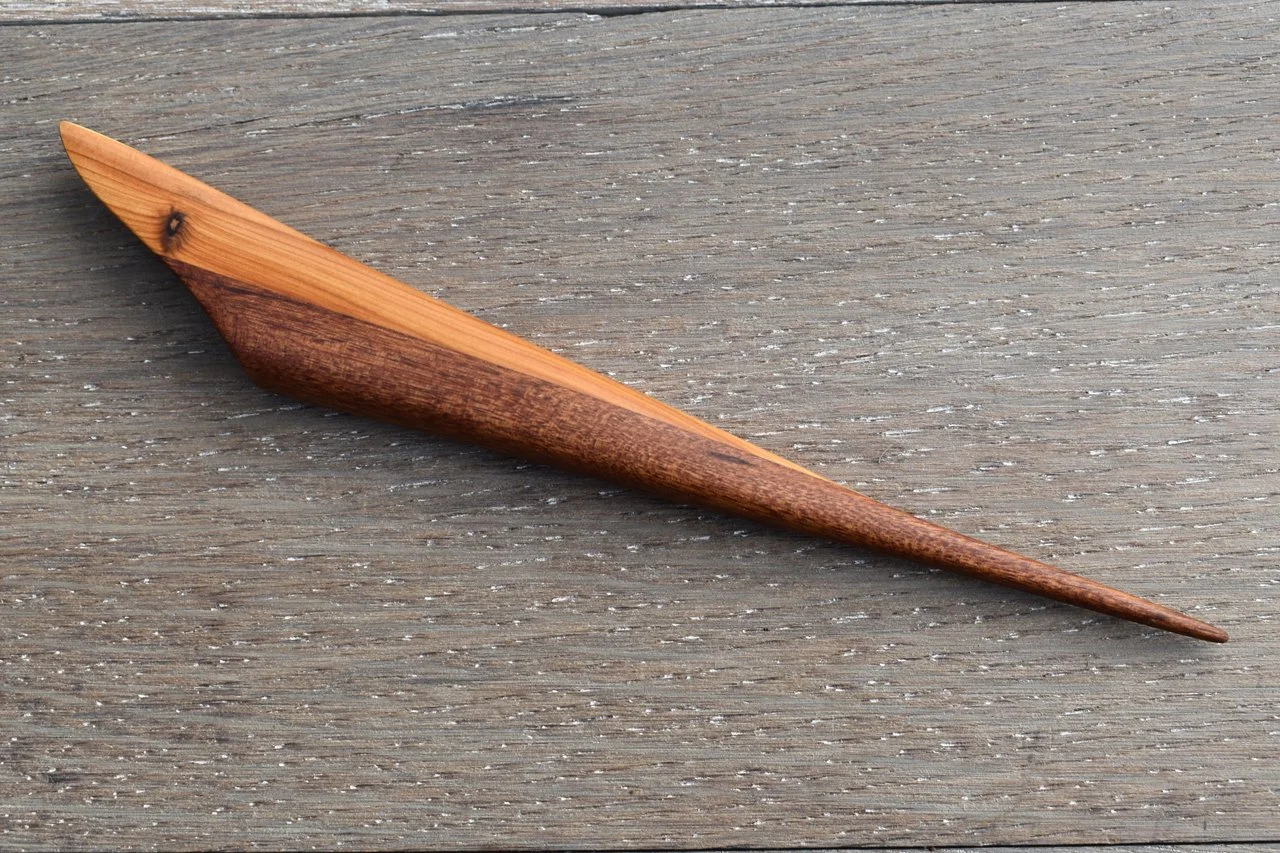
This handcrafted hair pin is made from Sapele wood and European Yew wood. The Sapele wood has a deep reddish hue in contrast to the rich coloured Yew wood. Small pale sap wood highlights appear at the tips of the Yew and the overall design is contemporary strong and compact.
Sapele Mahogany comes from West, Central and East Africa. It is often used in furniture and cabinet making and as a veneer for marquetry. It is also used in the construction of musical instruments, for building boats and as a flooring material. This piece arrived in its previous life as offcuts of flooring that would have otherwise been thrown away or burnt.
Yew has been used for many centuries. Longbows were made from Yew in the middle ages. Pegs or 'treenails' were cut for Viking ships. Furniture makers use Yew to form the bent parts of Windsor chairs. Pre-Christian cultures regarded the Yew tree as sacred. Possibly because of their longevity they became symbols of immortality. Drooping branches of a Yew can root and form a circle of new trunks around the original tree. Later the Yew came to symbolise death and resurrection in Celtic culture. Thanks to research into the properties of the Pacific Yew bark, and a subsequent discovery that the European Yew holds similar properties called alkaloids in its leaves, we now harness these alkaloids for treating ovarian and breast cancer. It remains one of the longest-lived trees on earth. This piece has been made from the trimmed branches of beautiful ancient tree that still stands strong in a valley near by.
Measurements:
14.2 cm Long
1.8 cm Wide
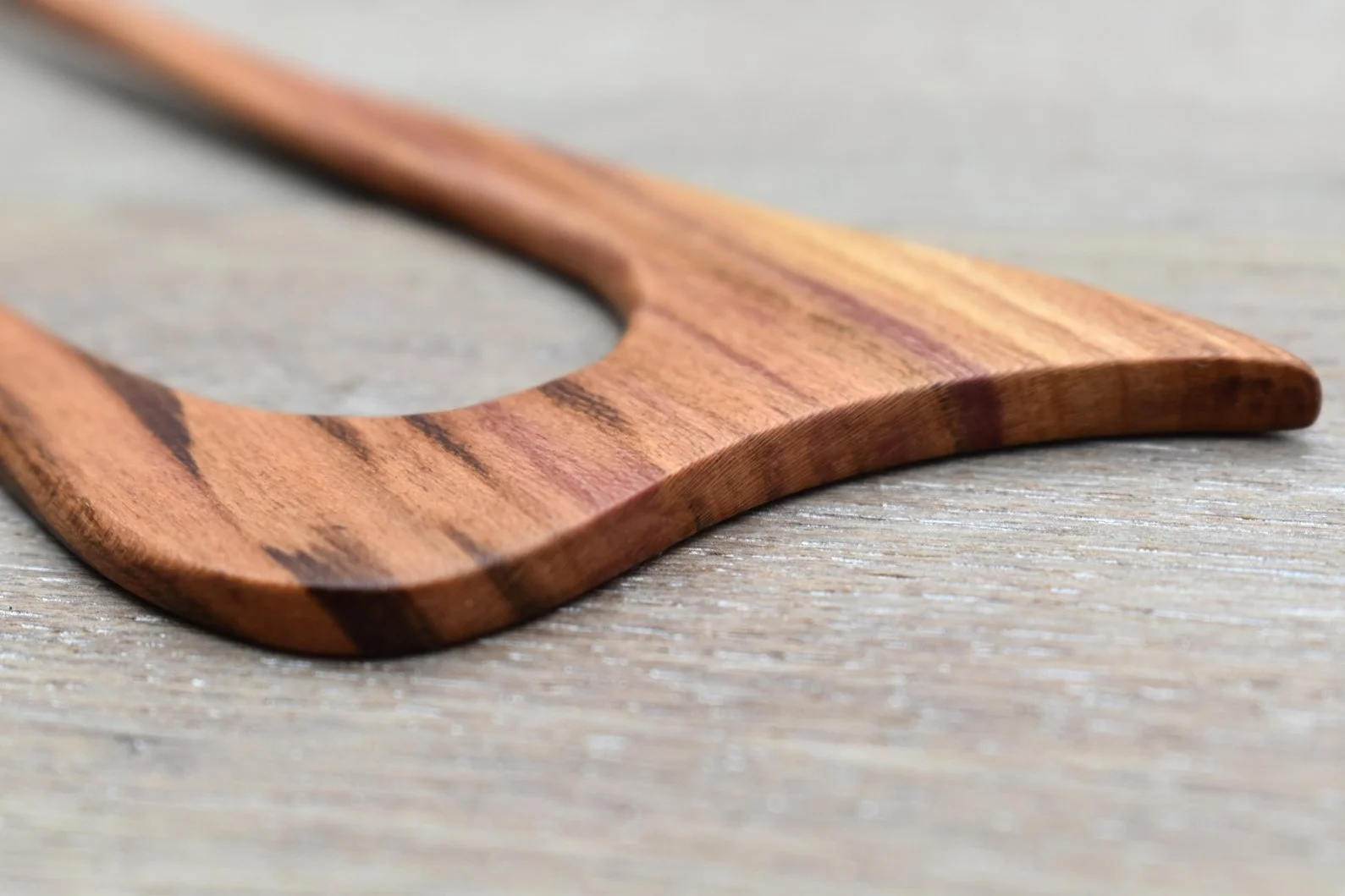
This wide handcrafted hair fork is made from a colourful piece of Red River Gum Eucalyptus. It features a fine grain with pink, purple and reddish orange striped hues across the whole fork making for a really lively colourful piece.
Red River Gum Eucalyptus is an iconic Australian tree. The timber has a reputation for durability, strength and its distinctive red colouring. Its wide availability has seen it used for a range of applications including heavy construction, railway sleepers, flooring, framing, fencing, plywood and veneer manufacture, wood turning, firewood and charcoal production. It was also commonly used as street paving throughout Sydney in the late 1800s. This piece was salvaged from a much loved giant that was felled in a garden in Bath in 2018.
Measurements:
15.3cm Long
6.5cm Wide
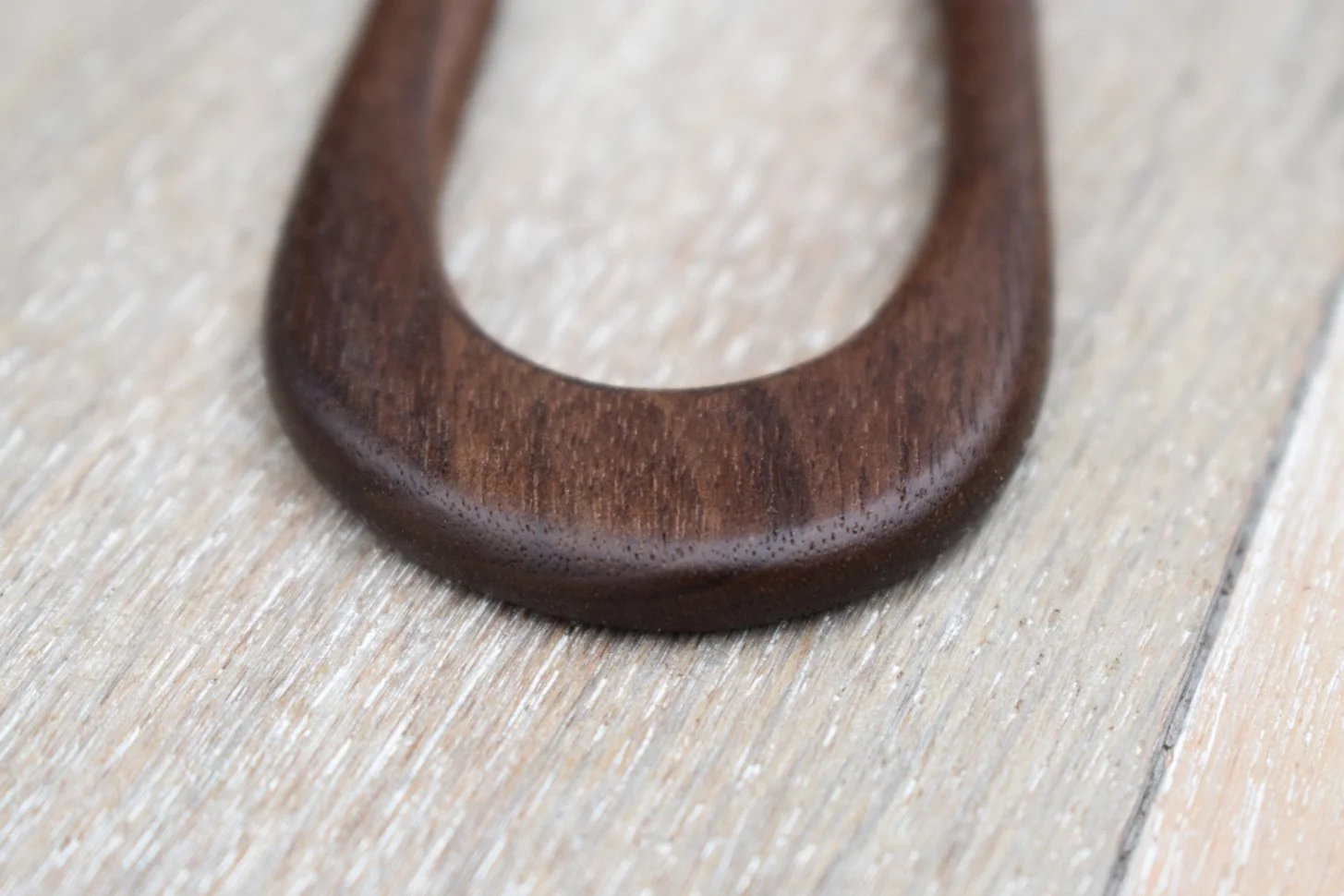
This handcrafted hair fork is made from a dark American Black Walnut with subtle grain. A classic, clean and light wieght fork.
American Black Walnut grows in Canada and Northern America. It is a prized wood for cabinetmaking and provides some pretty tasty nuts. The Black Walnut in this piece was salvaged from small bits of flooring and some off cuts from a nearby joinery workshop.
Measurements:
15.4cm Long
4.8cm Wide
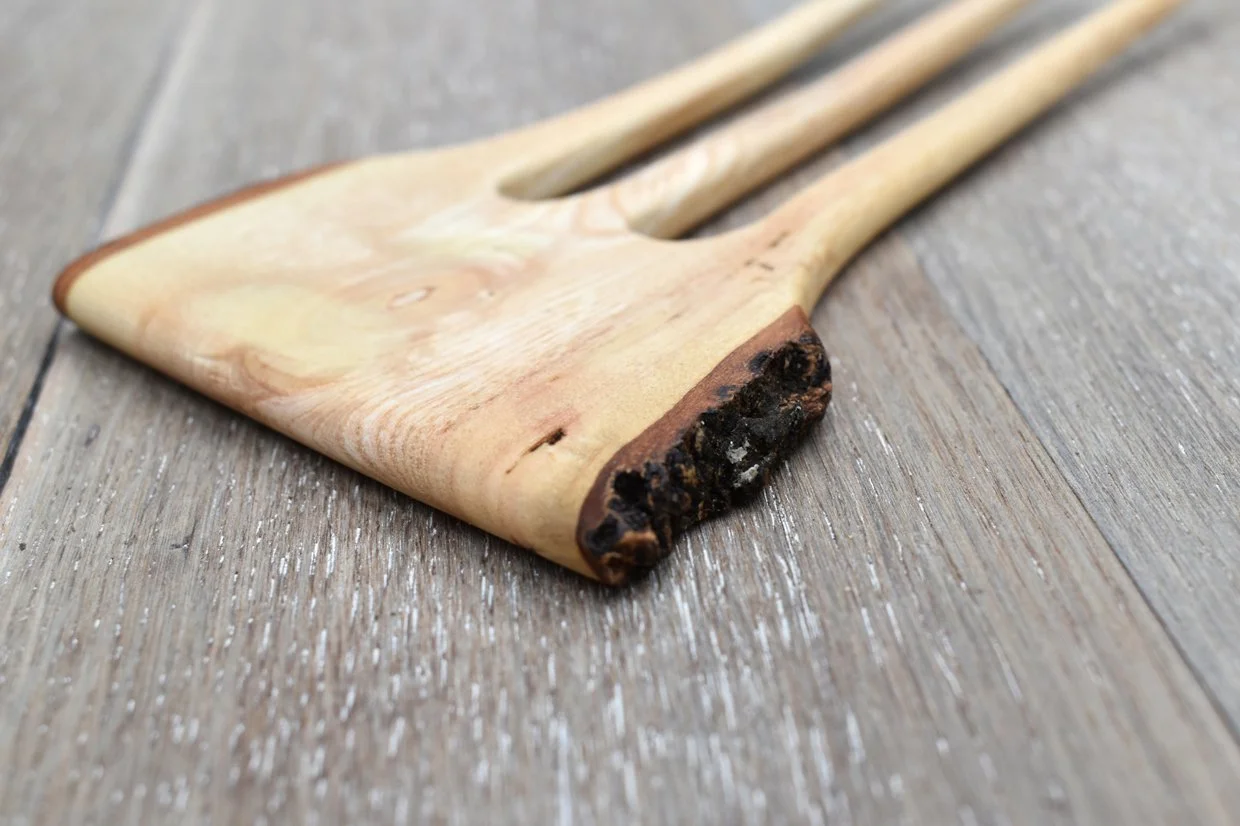
This large, wide, triple pin handcrafted hair fork is made from Ash wood with fine grain patterns at the top and live edge bark at the sides. It makes for a really eye catching piece. Perfect for big, volumous hair.
Ash is an amazing tree. It's part of the ‘Sacred Triad’ of Oak, Ash and Thorn, and the Irish ‘Seven Noble Trees’. European Ash is a prolific species forming a very important role in the ecosystem of woodlands across Europe. We are loosing many Ash trees due to Ash die back and so it is an abundant timber at the moment. This Ash was gathered from tree work and pruning jobs I carried out in a woodland in a valley near Bath.
Measurements:
16.9cm Long
8.5cm Wide
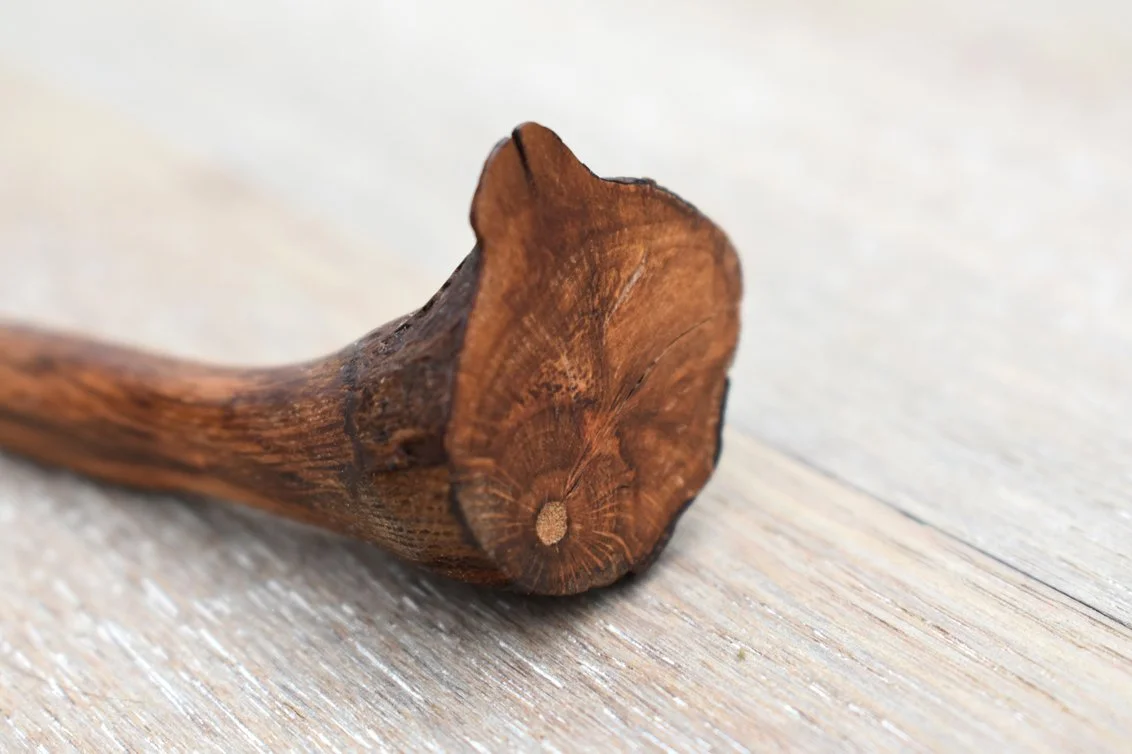
This handcrafted hair pin is made from Rosa Rubrifolia Wood. It features live edge bark at the top with a pith mark amongst stunning intricate end grain. Clear, dark, fine grain patterns with small knots run down the gently contoured piece. A strong, natural and beautiful pin.
Rose is possibly one of the most well known flowering shrubs in the UK. There are over three hundred species and tens of thousands of cultivars.
Rosa Rubrifolia is a type of Shrub rose that is famed for it's red leaves. It is native to the mountains of central and southern Europe and is a popular choice for gardens here in the UK.
This piece has been salvaged from a local garden in Wiltshire.
Measurements:
6.5cm Long
3.1cm Wide
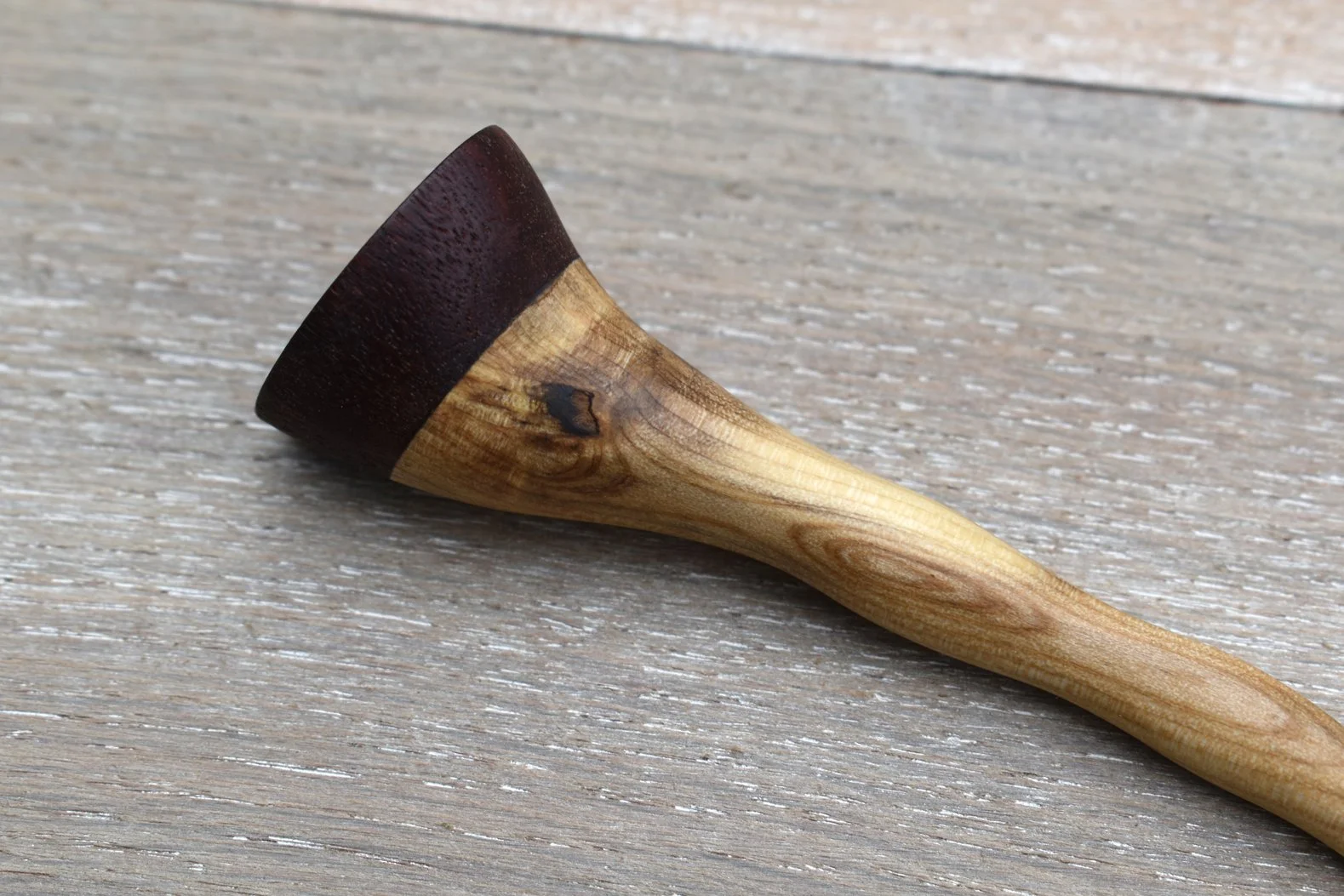
This handcrafted hair pin is made from lightweight pale Magnolia wood that has a silvery brown grain with a couple of knots towards the top. The clear grain patterns run down the contoured pin leading to a dark coloured tip. The top is made from a heavier contrasting dark Purpleheart.
Magnolia trees are familiar to many of us for their amazing display of flowers in the Spring. This versatile wood is often used in cabinetmaking, furniture, joinery, and much more. This particular piece was pruned from a beautiful tree in 2019 that still stands happily in a nearby village 2019.
Purpleheart is a very strong wood from south America. This piece was left over from a local carpentry workshop. It is one of my favourite woods to work with. Sapele Mahogany comes from West, Central and East Africa. It is often used in furniture and cabinet making and as a veneer for marquetry. It is also used in the construction of musical instruments, for building boats and as a flooring material.
Measurements:
17cm Long
3.2cm Wide
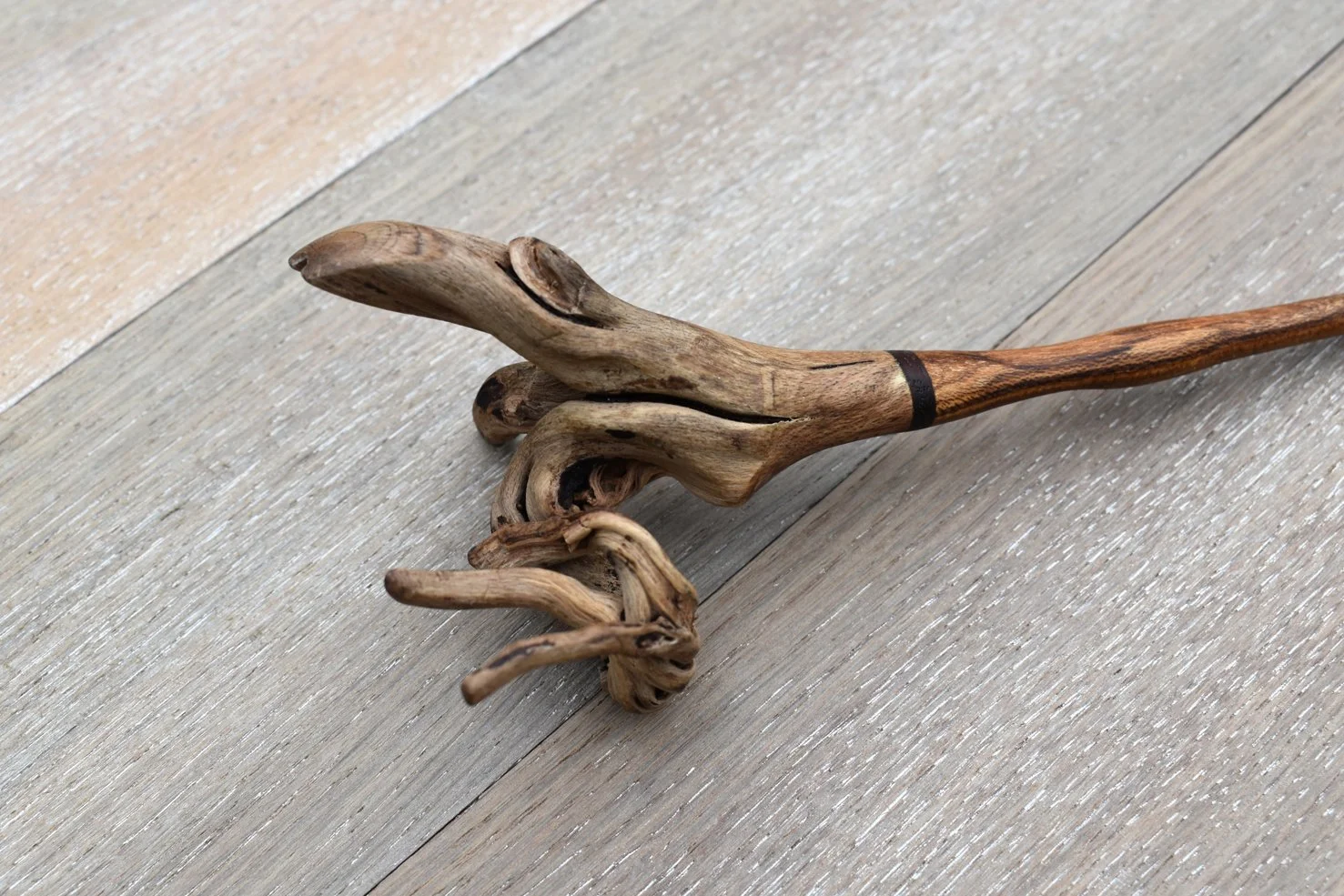
This unusual handcrafted pin is made from Lavender, Purpleheart and Laburnum wood. It features a natural gnarled and twisted 'fascinator' top that is sure to catch the eye. The collar has a band of dark Purpleheart wood and the rest of the length is made of gently contoured Laburnum wood with fine grain patterns running down the piece.
Lavender is a prised plant in the mint family. It has been widely used across Asia, The Middle East Europe and northern and eastern Africa for centuries. Best known for it's stunning flowers, unmistakable fragrance and powerful oil, this herb is a truly wonderful plant. Anyone who has stood in the middle of a lavender field can attest to this! It's a favourite herb in English cottage gardens thanks to the Romans who first introduced it to Britain and named the herb Lavare, after their word for 'to bathe'. Lavender boasts many medicinal and magical attributes and is famed for it's calming properties. It was ancient Arabia that first farmed the herb for it's potent oil.
The wood from lavender is rarely used and usually discarded once the old plants have lost their vigour. I have been so excited to work with this Lavender that came from a local garden in Wiltshire after a hard prune a couple of years ago. It has quickly become one of my favourite discoveries for making pins.
Purpleheart is a very strong wood from south America. This piece was left over from a local carpentry workshop. It is one of my favourite woods to work with. Sapele Mahogany comes from West, Central and East Africa. It is often used in furniture and cabinet making and as a veneer for marquetry. It is also used in the construction of musical instruments, for building boats and as a flooring material.
Laburnum wood is a stunning wood found in southern Europe and here in the UK. Prized by furniture makers and luthiers this beautiful deep grained wood is often used for veneers. It is one of the few woods we have in the UK that feels and behaves like rosewood. Cross cut sections of this wood called 'oysters' have been used to make furniture for centuries. A stunning tree and a gorgeous wood, it never fails to impress. This piece was salvaged from a very old tree that had fallen in a storm in 2012. I've saved as much of the old dear as I could and I can't wait to see what further wonders lie beneath the bark
Measurements:
19.5cm Long
6.4cm Wide

This handcrafted hair pin is made from lustrous Black Walnut, honey coloured Cherry with bark detail and Holly wood. A small piece of strengthening Oak has also been revealed through the Holly towards the top of the pin giving an unusual detail. The top of the pin features Cherry bark.
Holly is a very familiar tree for most of us. The timber is a very pale white and grey colour. It is typically used for inlays and furniture for it's pale colour. Holly has many traditions and uses among ancient european cultures.
American Black Walnut grows in Canada and Northern America. It is a prized wood for cabinetmaking and provides some pretty tasty nuts. This hair pin has been made from wood that would have otherwise been thrown away or burnt.
Favoured by furniture makers Cherry wood is hard and strong with a beautiful golden honey tone. The tree is an important food source for blackbirds, song thrush's and mammals such as the badger, wood mouse, yellow necked mouse and dormouse. Bees make their way to these beautiful trees in the spring for their abundant flower blossoms. This piece was taken from a Cherry near Bath that lost a large limb in a winter storm in 2015.
Measurements:
15.3cm Long
3.3cm Wide
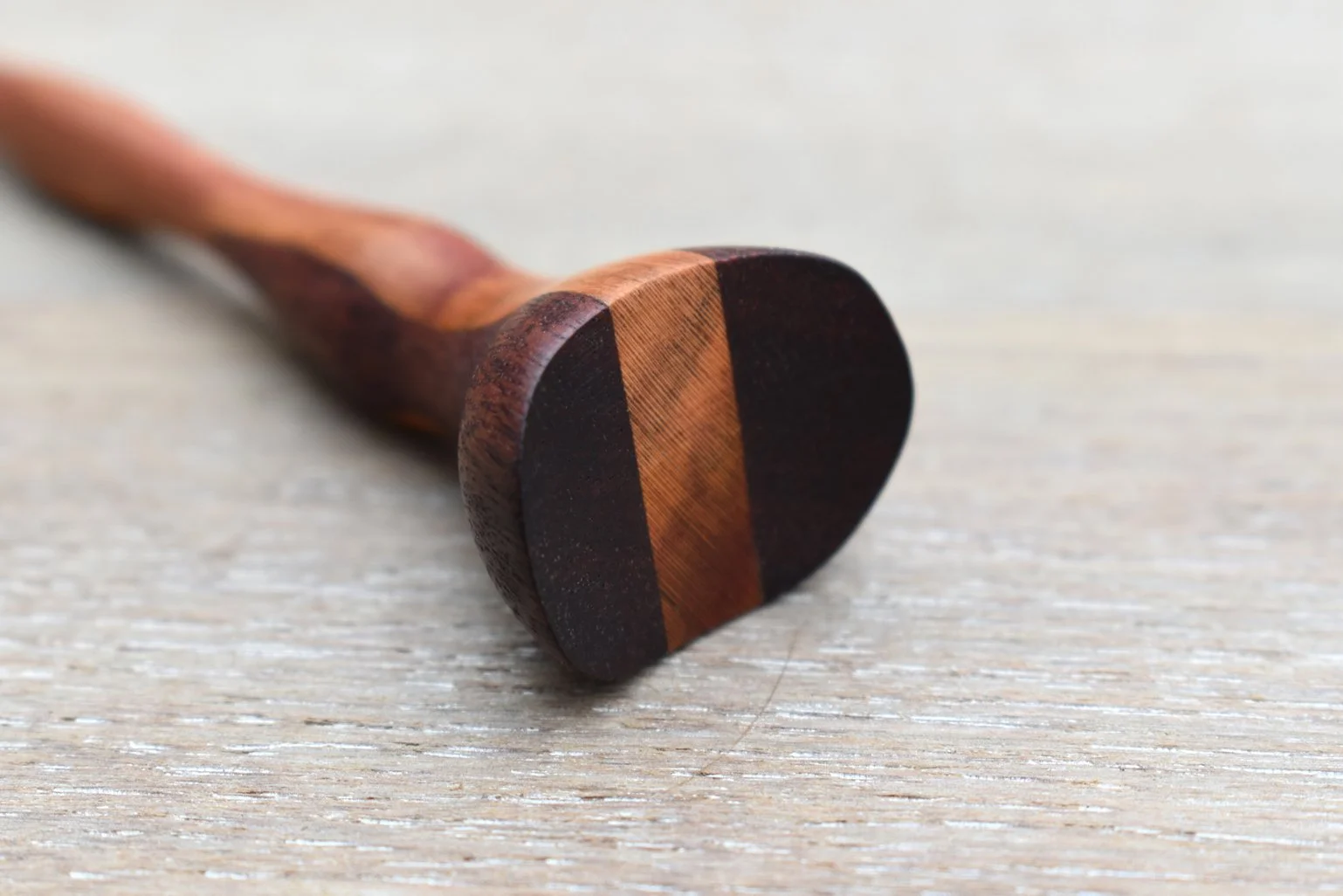
This long handcrafted hair pin is made from a deep coloured Red River Gum Eucalyptus wood that runs in a stripe through the top and continues down the contours of the pin. The top is made from a dark Purpleheart wood with a comforting curve at the end making for a very strong and tactile pin.
This handcrafted hair pin is made from Red River Gum Eucalyptus. It has a deep lustrous orange/red hue, a very pleasing scoop that fits your thumb perfectly at the top and intricate ribboning grain running down the length of this exceptionally strong pin.
Red River Gum Eucalyptus is an iconic Australian tree. The timber has a reputation for durability, strength and its distinctive red colouring. Its wide availability has seen it used for a range of applications including heavy construction, railway sleepers, flooring, framing, fencing, plywood and veneer manufacture, wood turning, firewood and charcoal production. It was also commonly used as street paving throughout Sydney in the late 1800s. This piece was salvaged from a much loved giant that was felled in a garden in Bath in 2018.
Purpleheart is a very strong wood from south America. This piece was left over from a local carpentry workshop. It is one of my favourite woods to work with. Sapele Mahogany comes from West, Central and East Africa. It is often used in furniture and cabinet making and as a veneer for marquetry. It is also used in the construction of musical instruments, for building boats and as a flooring material.
Measurements:
16.5cm Long
2.8cm Wide
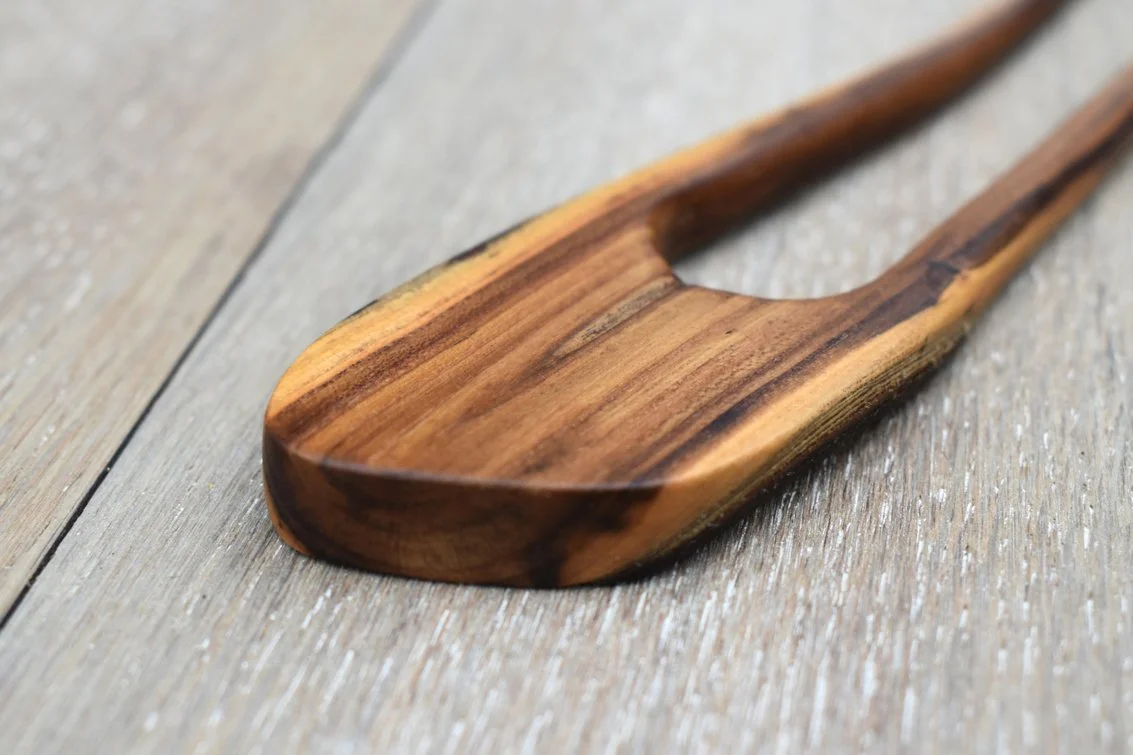
This handcrafted hair fork is made from a stunning piece of Elaeagnus Quicksilver wood. It features very dark bark and grain at the top with a pith mark a fine contrasting coloured grain running down the pins. A strong and eye catching fork.
Elaeagnus is a commonly found shrub here in UK gardens. Quicksilver is a lesser known variety with a more slender leaf than it's more common cousin. Elaeagnus has mostly been used for knife scales, bowls and pens etc as it is often multi stemmed. This shrub hides some impressive grain. Some know the tree as Russian Olive as it can resemble Olive wood.
This piece was pruned from a well established shrub here in Wiltshire in 2020.
Measurements:
15.7cm Long
3.8cm Wide